
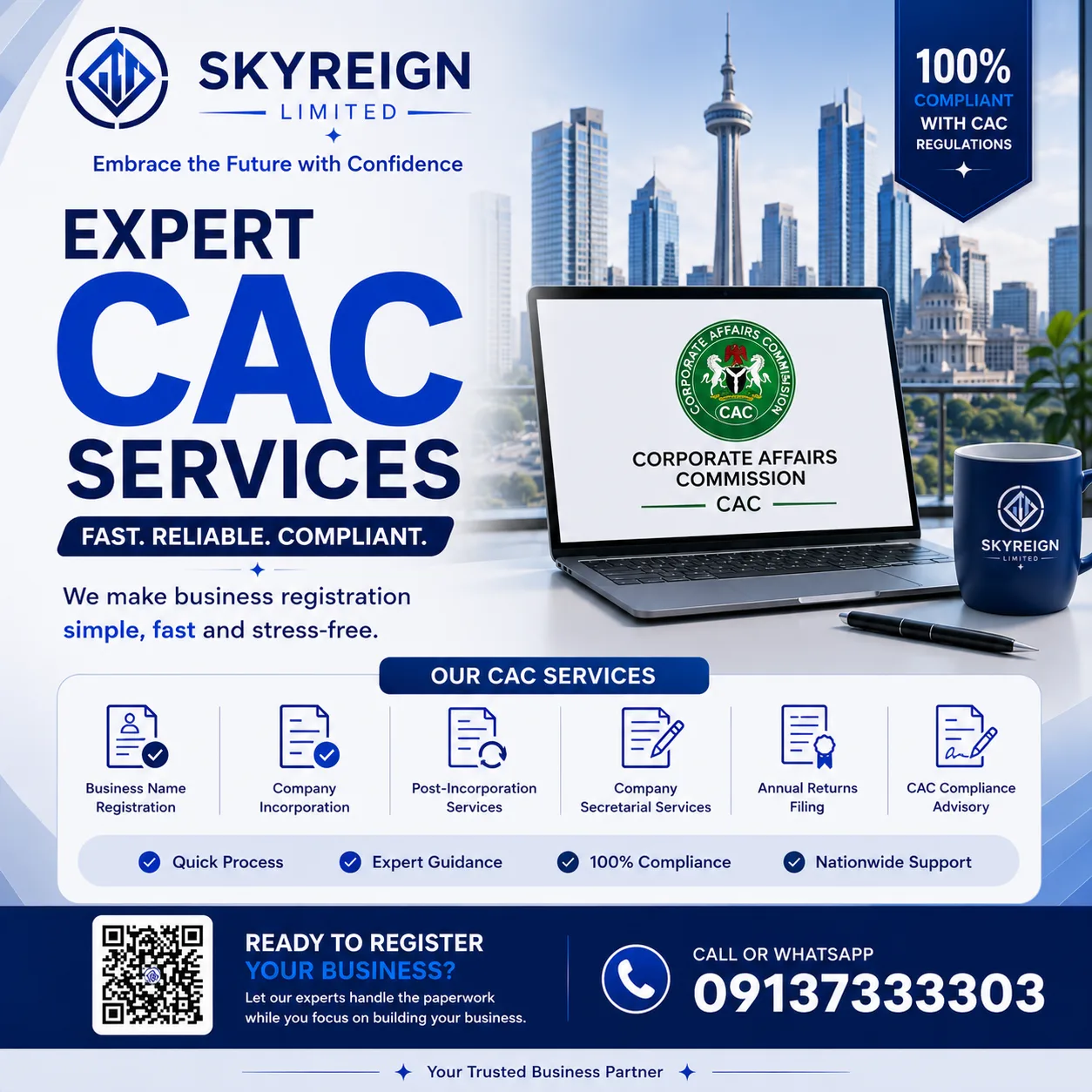
Starting a business in Nigeria is an important step towards building a sustainable enterprise.Whether you are opening a restaurant, Pos Buisness, Saloon, beauty and spa, consulting business, a real estate business, fintech, a technology company, a trading business or a professional services firm, understanding how to register a company with CAC in Nigeria can help you establish the right legal structure from the beginning.
The Corporate Affairs Commission (CAC) is the government agency responsible for registering companies, business names and other business entities in Nigeria. Its online Company Registration Portal allows eligible applicants to complete registration processes electronically. At SkyReign Limited, we help entrepreneurs and business owners navigate company registration, business documentation and corporate compliance requirements so they can focus on building their businesses.
This guide explains how to register a company in Nigeria, the documents you may need, the difference between a business name and a limited liability company, registration costs and important steps to consider after incorporation.
What Is CAC Registration in Nigeria?
CAC registration is the formal process of registering a business entity with the Corporate Affairs Commission under the applicable Nigerian legal framework. Depending on the structure you choose, you may register a business name or incorporate a company, such as a private company limited by shares.
Registering your business can help establish its legal identity, improve business credibility and support activities such as opening a corporate bank account, entering contracts and applying for opportunities that require formal business registration.
However, CAC registration does not automatically provide every licence or regulatory approval that a business may need to operate in a regulated industry.
Types of Business Registration Available Through CAC
Before starting your CAC registration in Nigeria, determine which legal structure is suitable for your business activities, ownership arrangements and future plans.
1. Business Name Registration A business name is commonly used by sole proprietors and partnerships operating under a trading name. This option may suit small businesses, freelancers, consultants and entrepreneurs who want to establish a registered business name without incorporating a limited liability company. A registered business name is not a separate legal person in the same way as an incorporated company.
2. Private Limited Liability Company A private company limited by shares is a separate legal entity from its owners. It may be suitable for businesses that intend to enter formal contracts, build a corporate structure, employ staff, seek investment or expand operations. Examples include consulting firms, real estate companies, technology businesses, procurement companies and professional service providers. The requirements depend on the applicable company type, ownership structure and circumstances.
3. Company Limited by Guarantee A company limited by guarantee is generally used for purposes that are not intended to distribute profits to members as dividends. It has specific legal requirements and is not the standard structure for an ordinary profit-making business.
Which option should you choose? The right structure depends on your business objectives, liability considerations, ownership and regulatory requirements. If you intend to build a company that can operate independently of its founders, a private limited liability company may be worth considering.
Requirements for CAC Company Registration in Nigeria The documents and information required for CAC registration depend on whether you are registering a business name or incorporating a company.
For a typical private company registration, prepare the following information where applicable: • Proposed company name and alternative name.
- Principal business activity and proposed objects of the company.
- Registered office address and contact details.
- Details of the directors and shareholders.
- Proposed share capital and share allocation.
- Required identification details and supporting documents.
- Details of persons with significant control (PSC), where applicable.
- Memorandum and Articles of Association, as applicable to the proposed company.
- Other declarations, documents and information required by the CAC portal for the specific application.
For a business name registration, the information required is generally simpler and depends on the particulars of the proprietor or partners.
Ensure that names, addresses, identification details, ownership information and share allocations are accurate and consistent throughout the application.
How to Register a Company with CAC in Nigeria: Step-by-Step Process
Step 1: Choose a Suitable Business Structure Decide whether to register a business name or incorporate a company. Consider your business objectives, the number of owners, liability, shareholding arrangements, intended contracts and any industry-specific requirements. For example, an entrepreneur intending to operate a real estate advisory firm with several shareholders may prefer to consider a private company limited by shares rather than a business name.
Step 2: Conduct a CAC Name Availability Search Choose a distinctive name that reflects your business identity and activities. Conduct a preliminary name search through the official CAC portal to determine whether your proposed name may be available. Avoid names that are identical or confusingly similar to existing registered names, or that contain restricted words without the required approval. A preliminary search does not guarantee that a name will be approved.
Step 3: Reserve Your Proposed Business or Company Name Once you have selected a suitable name, submit a formal name reservation application through the relevant CAC registration process. The name must be approved before you proceed with the associated registration application. Follow the portal's instructions and pay the applicable reservation fee shown by the CAC.
Step 4: Prepare the Required Registration Information Before completing the application, organise the details needed for the registration.
For a company, this may include:
- Directors' particulars.
- Shareholders' particulars.
- Share capital and allocation of shares.
- Registered office address.
- Principal business activities.
- Persons with significant control information.
- Applicable constitutional documents and declarations.
Where a company has corporate shareholders, holding-company arrangements or indirect ownership, pay particular attention to the ownership and control information. The particulars of persons with significant control should reflect the applicable disclosure requirements.
Step 5: Complete the Online CAC Registration Application Access the official CAC Company Registration Portal and create or sign in to the appropriate account. Complete the relevant electronic forms carefully. The information entered should agree with the supporting documents and the proposed ownership structure. For a business name, the applicable business name pre-registration process is different from the company incorporation process.
You can begin through the official portal: https://icrp.cac.gov.ng/
Step 6: Upload Supporting Documents and Pay the Applicable Fees Upload the documents requested for your application and review all entries before submission. Pay the applicable CAC filing fees and statutory stamp duties, where required, through the approved payment process.
The total cost of CAC registration in Nigeria depends on the type of registration, share capital where applicable, the relevant fee schedule and any additional services you choose to use. For this reason, confirm current charges directly through the official CAC portal rather than relying on outdated prices published online.
Step 7: Monitor Your Application and Respond to Queries
After submission, monitor the status of your application through the portal. If the CAC raises a query, read it carefully and provide the requested corrections or documents. Common areas that may require attention include inconsistencies in names, incomplete particulars, errors in share allocation, missing identification documents, unclear business objects and incomplete persons-with-significant-control disclosures.
A carefully prepared application can help reduce avoidable errors, although approval and processing time remain subject to the CAC's procedures.
Step 8: Obtain Your CAC Registration Documents
When the application is approved, retrieve the relevant electronic registration documents through the official portal.
Depending on the entity registered, these may include: • Certificate of Incorporation for an incorporated company, or Certificate of Registration for a business name.
- Applicable registration extracts or status documents.
- Memorandum and Articles of Association, where applicable.
- Other approved registration records available for the entity.
Review the documents to ensure that the company name, registration number, registered address, directors and other relevant particulars are correct.
Keep secure copies for your records and future business transactions. How Much Does CAC Company Registration Cost in Nigeria?
The cost of CAC registration is not the same for every business. The amount payable may depend on:
- Whether you are registering a business name or incorporating a company.
- The applicable CAC filing fees.
- The company's share capital and registration category.
- Statutory stamp duties, where applicable.
- Optional professional assistance or other services.
For the current official charges, consult the CAC website and fee schedule: https://www.cac.gov.ng/ If you engage a registration consultant, ask for a clear breakdown separating official government charges from professional service fees.
This helps you understand what you are paying for and avoid unexpected costs. How Long Does CAC Registration Take?
CAC registration timelines can vary depending on the type of application, completeness of the submission, availability of the proposed name, portal processes and whether the application requires corrections.
Submitting accurate information and the required documents from the outset may help reduce delays. Avoid relying on a guaranteed turnaround time unless it is supported by the current official service information and the circumstances of your application.
What Should You Do After CAC Registration? Obtaining your CAC certificate is an important milestone, but it may not be the end of your business setup process.
Consider the following steps, as applicable to your business.
1. Review Your Tax Registration and Obligations Confirm your company's tax identification and registration position with the relevant tax authority. Understand the tax filings, records and other obligations applicable to your business. Requirements depend on the entity, its activities and the tax rules in force.
2. Open a Corporate Bank Account If your business requires a corporate bank account, contact your chosen bank to confirm its account-opening requirements. The bank may request your CAC documents, identification, ownership information, tax details and other supporting documents.
3. Maintain Proper Company Records Keep your incorporation documents, ownership records, resolutions, financial records and other statutory information organised. Notify the CAC of changes that require formal filings, such as relevant changes to directors, registered office details, shareholding or other company particulars.
4. Understand Annual Returns and Other Filings Companies and business names may have applicable annual return and other filing obligations under the relevant rules.
Keep track of due dates and confirm the requirements applicable to your entity. Do not assume that registration alone fulfils ongoing compliance obligations.
5. Obtain Additional Permits Where Necessary Some businesses require additional licences, registrations or permits depending on their activities. For example, a business operating in a regulated sector may need approval from the relevant sector regulator in addition to CAC registration.
The applicable requirements should be checked against the specific business activity. Common CAC Registration Mistakes to Avoid.
Entrepreneurs can reduce avoidable registration problems by paying attention to the following: Choosing an unsuitable business structure: Consider your business model and future ownership plans before submitting the application.
Using an unavailable or restricted name: Conduct the appropriate search and follow the formal reservation process.
Submitting inconsistent information: Ensure that the names, addresses, ownership details and share allocations match throughout the application.
Writing vague business objects: Describe the intended business activities accurately and ensure that the proposed objects are appropriate for the company.
Ignoring persons-with-significant-control requirements: Determine the applicable disclosure requirements and report ownership or control information accurately. Assuming CAC registration covers every licence: Check whether your business needs additional permits or sector approvals. Neglecting post-registration compliance: Keep records and track applicable filings after the registration has been approved.
Frequently Asked Questions About CAC Registration in Nigeria Can I register a company with CAC online?
Yes. The CAC provides an online Company Registration Portal through which applicants can complete the applicable registration process, submit information, pay fees and access approved electronic registration documents.
Official portal: https://icrp.cac.gov.ng/ Can I register a business name without incorporating a limited liability company? Yes. CAC provides a separate business name registration process. This may be suitable for eligible sole proprietors and partnerships that do not require an incorporated company structure. What is the difference between a business name and a limited liability company?
A business name is a registered trading name used by its proprietor or partners. A company incorporated under the applicable company law is a separate legal entity. The appropriate choice depends on ownership, liability, business objectives and other relevant considerations. Do I need a consultant to register my company with CAC?
Some eligible applicants can complete the registration process themselves through the official portal. However, professional assistance may be useful where the proposed ownership is complex, the company has corporate shareholders, the business requires carefully drafted objects or the application involves technical compliance considerations.
Can I change my company details after registration? Certain company particulars can be changed through the applicable CAC post-incorporation filing procedures. The required documents and approvals depend on the type of change. Is CAC registration enough to start operating a business in Nigeria?
Not necessarily. CAC registration establishes the relevant business registration or corporate status, but additional tax, sector-specific, local or other regulatory requirements may apply depending on the business.
Need Help with CAC Company Registration in Nigeria? Registering a business is an important step towards building a credible and organised enterprise. Choosing an appropriate structure, preparing accurate information and understanding your post-registration obligations can help you establish a stronger foundation.
SkyReign Limited provides business registration assistance, corporate documentation support and compliance-related services to entrepreneurs and businesses in Nigeria.
Whether you need help registering a business name, incorporating a private limited liability company, preparing company objects or understanding applicable post-registration filings, our team can help you navigate the process.
Visit our website to learn more about our services: https://www.skyreigngroup.com/
SkyReign Limited — Embrace the Future with Confidence.
Disclaimer: This article provides general information and is not a substitute for legal, tax or other professional advice tailored to your circumstances. CAC procedures, fees and regulatory requirements may change. Confirm current requirements with the relevant authorities before applying.