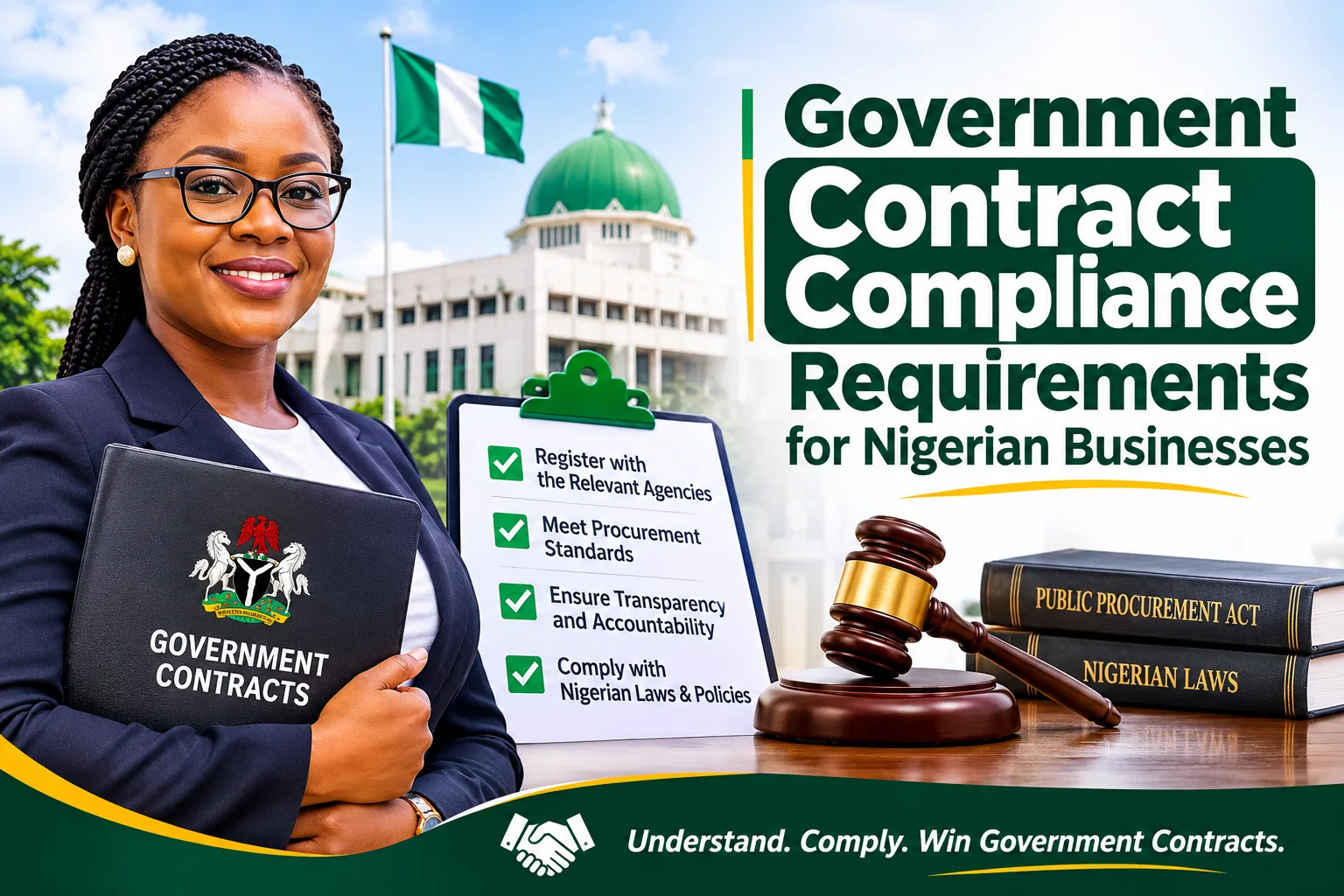
Winning a government contract in Nigeria can create significant opportunities for business growth, increased revenue, and long-term business relationships. However, before a company can successfully participate in public procurement, it must meet the eligibility and documentation requirements specified by the procuring government agency.
Many Nigerian businesses, particularly small and medium-sized enterprises (SMEs), suppliers, contractors, and consultancy firms, discover compliance gaps only when a tender opportunity becomes available. Some companies have valid Corporate Affairs Commission (CAC) registration but lack current tax records. Others have outstanding annual returns, incomplete corporate documents, or have not obtained the relevant statutory compliance certificates.
These gaps can affect a company's eligibility for government contracts. Whether you operate a construction company, consultancy firm, procurement business, supply company, real estate business, or general contracting company, preparing your compliance documents in advance is an important part of becoming procurement-ready.
In this guide, SkyReign Limited explains 10 important compliance documents and requirements Nigerian businesses should understand when preparing for government contracts, public procurement opportunities, and corporate tenders in 2026.
1. Corporate Affairs Commission (CAC) Registration Documents
The first step towards preparing your business for government contracts in Nigeria is ensuring that your business is properly registered with the Corporate Affairs Commission (CAC). Government agencies generally require bidders to provide evidence of legal registration before participating in procurement exercises. Depending on the nature of the business and the tender requirements, acceptable registration documents may include:
- Certificate of Incorporation.
- Memorandum and Articles of Association (MEMART), where applicable.
- CAC status report or verified company profile.
- Particulars of directors.
- Particulars of shareholders and persons with significant control (PSC), where required.
- Relevant post-incorporation filings.
- Evidence of current company status.
Your company's registered business activities should also be relevant to the goods, works, or services being offered.
For example, a company intending to bid for supply contracts should have appropriate business objects covering supply, procurement, distribution, or related activities. A consultancy firm should have relevant consultancy and professional service objects, while a construction company should have appropriate construction-related business activities.
Why this matters: Incomplete registration documents, inconsistent company information, or unsuitable business objects can create complications during tender evaluation. Businesses should also ensure that their CAC records reflect relevant changes in directors, shareholders, registered addresses, and shareholding structures.
2. CAC Annual Returns and Post-Incorporation Compliance
Registering a company with the CAC is not the end of its corporate obligations. Companies are required to maintain their statutory records and comply with applicable post-incorporation filing requirements, including annual returns. CAC annual returns provide an update on the company's statutory information and continued compliance with corporate filing obligations.
Businesses preparing for government contracts should review:
- Outstanding CAC annual returns.
- Changes in directors and shareholders.
- Changes in registered office addresses.
- Changes in share capital, where applicable.
- Persons with Significant Control (PSC) information.
- Other relevant post-incorporation filings.
An inactive or non-compliant company record may create unnecessary challenges when a procuring organization requests evidence of current corporate status. Practical recommendation: Conduct a CAC compliance review before applying for government contracts. Confirm that your company information is accurate and that outstanding statutory filings have been addressed.
3. Tax Identification Number (TIN) and Tax Registration
Tax compliance is a fundamental requirement for businesses operating in Nigeria. Companies seeking government contracts should ensure that their tax registration details are accurate and that their tax obligations are properly managed. A Tax Identification Number (TIN) is used to identify a taxpayer within the tax administration system. Businesses should ensure that:
- Their tax registration details are accurate.
- Their corporate identity corresponds with their CAC records.
- Applicable tax returns are filed.
- Outstanding tax liabilities are properly assessed and addressed.
- Relevant tax records are maintained.
Under Nigeria's evolving tax administration framework, businesses should also understand their obligations under the applicable tax laws and regulations.
Having a TIN alone does not automatically establish full tax compliance. Companies must also meet their relevant filing and payment obligations.
4. Tax Clearance Certificate (TCC)
A Tax Clearance Certificate (TCC) is one of the important documents frequently requested during government procurement exercises in Nigeria. A TCC provides evidence of a taxpayer's tax position for the relevant assessment years. Many federal government tenders require a company to provide a Tax Clearance Certificate covering the preceding three years. For example, a 2026 procurement notice may request evidence of company income tax compliance for 2023, 2024 and 2025, subject to the specific tender conditions. To prepare for a Tax Clearance Certificate application, businesses should review:
- Company income tax records.
- Annual tax returns.
- Audited financial statements, where applicable.
- Tax assessments and payment records.
- Outstanding tax liabilities.
- Applicable withholding tax and VAT obligations.
Companies should not wait until a tender is advertised before reviewing their tax records. An unresolved tax assessment, outstanding filing, or inaccurate financial information can delay the process of obtaining a TCC.
Important: A Tax Clearance Certificate does not mean that a company is exempt from future tax obligations. Businesses must continue meeting their applicable tax filing and payment requirements.
5. PENCOM Pension Compliance Certificate
Pension compliance is another requirement that may apply to companies participating in government procurement. The National Pension Commission (PenCom) regulates and supervises Nigeria's contributory pension system. Employers covered by the applicable pension legislation must meet the relevant pension obligations for their employees. Depending on the tender and the applicable legal requirements, procuring entities may request a Pension Compliance Certificate (PCC). Businesses should review:
- Employer registration with the relevant pension authorities.
- Employee pension registration.
- Remittance of applicable pension contributions.
- Employer and employee contribution records.
- Other supporting documentation required by PenCom.
Not every business automatically has the same pension compliance requirements. Applicability depends on the relevant legislation and circumstances.
Some procurement notices expressly provide alternative documentation, such as a sworn affidavit, for businesses below specified employee thresholds. Companies should therefore verify the requirements applicable to their workforce and the particular procurement opportunity.
6. Industrial Training Fund (ITF) Registration and Compliance
The Industrial Training Fund (ITF) is responsible for promoting and supporting skills development and industrial training in Nigeria.
Eligible employers are required to comply with the applicable provisions of the Industrial Training Fund Act, including relevant registration and contribution obligations.
ITF compliance is frequently included in government tender requirements. Depending on the applicable legislation and tender conditions, businesses may need to provide:
- Evidence of ITF registration.
- ITF compliance certificate.
- Relevant contribution and payment records.
- Other supporting documents requested by the ITF.
Certain procurement notices specify employee and annual turnover thresholds when determining whether ITF compliance documentation is required.
For example, a tender may apply the requirement to companies with five or more employees or an annual turnover of ₦50 million and above.
Businesses should not assume that every company is automatically required to obtain the same ITF documentation. Confirm the applicable statutory thresholds and tender requirements.
7. Nigeria Social Insurance Trust Fund (NSITF) Compliance
The Nigeria Social Insurance Trust Fund (NSITF) administers the Employees' Compensation Scheme under the Employees' Compensation Act.
The scheme provides compensation for employees who suffer work-related injuries, disabilities, or other qualifying employment-related incidents.
Businesses that fall within the applicable statutory requirements should ensure that their NSITF obligations are properly addressed.
For government contract applications, procuring entities may request an NSITF compliance certificate. Relevant documentation may include:
- NSITF employer registration.
- Evidence of applicable contributions.
- Employee-related records.
- NSITF compliance certificate.
- Other supporting documents requested by the Fund.
NSITF compliance is particularly relevant to businesses operating in construction, logistics, manufacturing, engineering, facilities management, and other sectors with employee-related operational risks.
Companies should review their obligations before submitting tender applications.
8. Bureau of Public Procurement (BPP) Registration
The Bureau of Public Procurement (BPP) is responsible for regulating and monitoring public procurement in Nigeria under the Public Procurement Act 2007.
Businesses seeking federal government procurement opportunities should understand the National Database of Federal Contractors, Consultants and Service Providers.
Depending on the procurement exercise, bidders may be required to provide evidence of registration on the database, including an Interim Registration Report (IRR), or other documentation specified in the tender.
Businesses should review the applicable registration requirements and ensure that their company information is accurate.
Common information required during contractor registration and procurement preparation may include:
- CAC registration documents.
- Company profile.
- Tax identification details.
- Relevant business activities.
- Directors' and company information.
- Contact information.
- Other supporting documents required by the registration platform.
It is important to understand that BPP registration does not guarantee the award of a government contract.
Companies must still meet the technical, financial, professional, and other eligibility requirements of individual tenders.
9. Company Audited Accounts and Financial Statements
Financial documentation is an important part of government procurement. Procuring organisations often request audited financial statements to assess the financial capacity and credibility of prospective contractors.
Depending on the tender, a company may be required to submit audited accounts for the last three financial years.
Financial documents may include:
- Audited financial statements.
- Statement of financial position.
- Statement of profit or loss.
- Cash flow statements, where applicable.
- Relevant audit reports.
- Bank reference letters.
- Evidence of financial capability.
- Other financial documents specified in the tender.
For example, a company bidding for a major construction or supply contract may be required to demonstrate sufficient financial capacity to execute the project.
Businesses should ensure that their financial statements are properly prepared and consistent with their tax filings and other corporate records.
Where a company is newly incorporated and does not have three years of operating history, it should carefully review the tender's provisions rather than assume that it qualifies or is automatically disqualified.
10. Company Profile, Technical Experience and Supporting Documents Having all statutory compliance certificates does not automatically make a company eligible for every government contract.
Procurement exercises also assess the bidder's technical capacity, experience, and ability to execute the proposed project.
A professional company profile helps communicate the company's identity, capabilities, experience, and areas of specialisation.
A comprehensive company profile should include:
1. Company background and history.
2. Vision, mission, and corporate values.
3. Description of goods and services.
4. Management and organisational structure.
5. Relevant staff qualifications and professional certifications.
6. Previous projects and completed contracts.
7. Client references, where appropriate.
8. Equipment and operational capacity.
9. Contact details and registered business address.
Depending on the tender, additional documents may include:
- Evidence of similar projects executed.
- Project completion certificates.
- Letters of recommendation.
- Professional licences and certifications.
- Equipment ownership or lease agreements.
- Technical proposals.
- Work plans and delivery schedules.
- Sworn affidavits and declarations.
A company should only present genuine experience, qualifications, and project records. Misrepresentation can lead to disqualification and other consequences. Additional Compliance Requirements Nigerian Businesses Should Understand Beyond the ten major areas discussed above, certain businesses may have additional regulatory obligations depending on their industry, activities, and the nature of the contract.
SCUML Registration The Special Control Unit Against Money Laundering (SCUML) supervises applicable Designated Non-Financial Businesses and Professions (DNFBPs) for anti-money laundering and counter-terrorism financing compliance.
Businesses operating in designated categories should determine whether SCUML registration and related AML/CFT obligations apply to them.
Relevant categories may include certain real estate businesses, dealers in precious metals and stones, and other designated business or professional activities.
SCUML registration is not a universal requirement for every Nigerian company. Businesses should confirm their classification under the applicable regulatory framework. VAT Registration and Filing
Businesses should understand their applicable Value Added Tax (VAT) registration, collection, filing, and remittance obligations.
Where applicable, companies should maintain accurate VAT records and file returns within the prescribed timelines. Even where there are no taxable transactions for a particular filing period, businesses should establish whether a nil return is required under the applicable rules.
Withholding Tax (WHT) Withholding tax obligations may arise when businesses make qualifying payments or receive payments subject to withholding tax under Nigerian tax legislation. Companies should maintain proper records of deductions, remittances, and applicable withholding tax credit notes.
Business Permits and Sector-Specific Licences Some procurement opportunities require additional licences, registrations, or professional approvals. For example, companies operating in regulated sectors may need approvals from relevant government agencies before undertaking specific activities.
A business should therefore examine the technical and regulatory conditions of each tender. Government Contract Compliance Checklist for Nigerian Businesses Before submitting a tender, use this checklist to review your company's readiness. • Valid CAC Certificate of Incorporation or applicable registration certificate.
- Updated CAC company records and status report.
- Relevant MEMART and post-incorporation documents.
- Up-to-date CAC annual returns, where applicable.
- Valid TIN and accurate tax registration records.
- Tax Clearance Certificate for the required assessment years.
- PENCOM compliance documentation, where applicable.
- ITF compliance documentation, where applicable.
- NSITF compliance documentation, where applicable.
- BPP registration or Interim Registration Report, where required.
- Audited financial statements for the required years.
- Company profile and relevant technical documents.
- Evidence of previous projects and experience.
- Sector-specific licences and regulatory approvals, where applicable.
- Required affidavits and declarations.
Remember: This is a general preparation checklist, not a universal list of mandatory documents. The actual requirements depend on the procuring organisation, procurement category, applicable laws, and specific tender notice.
Common Mistakes That Can Affect Your Government Contract Application Many Nigerian businesses lose valuable opportunities because they do not prepare their documentation early enough.
Some common mistakes include:
1. Waiting until a tender is advertised
Some compliance documents require verification, preparation, or processing. Starting late can create unnecessary pressure.
2. Using outdated CAC documents Company information should be current and consistent across registration records, tax documents, and tender submissions.
3. Ignoring tax obligations Outstanding tax returns, unpaid assessments, and incomplete tax records can affect the process of obtaining a Tax Clearance Certificate.
4. Assuming every compliance certificate applies to every business PENCOM, ITF, NSITF, and other requirements should be assessed based on applicable legislation and the specific tender conditions.
5. Submitting inconsistent information Differences in company names, addresses, directors, financial records, and registration details can raise questions during verification.
6. Preparing a weak company profile A company profile that does not communicate relevant experience, capabilities, and services may weaken the overall presentation of a tender application.
7. Failing to read the tender instructions Every procurement exercise has its own eligibility criteria, submission format, deadlines, and technical requirements. Businesses must follow the specific instructions provided.
How SkyReign Limited Helps Nigerian Businesses Prepare for Compliance Preparing a company for government contracts requires more than obtaining a CAC certificate. It involves understanding corporate obligations, maintaining accurate records, addressing applicable tax requirements, and organising relevant compliance documents.
SkyReign Limited is a Nigerian business consulting and real estate advisory company supporting businesses with registration, compliance, documentation, and business development services. Our services include:
CAC Business Registration and Post-Incorporation Services We support entrepreneurs and businesses with company registration, business name registration, post-incorporation filings, annual returns, company information updates, and other applicable corporate compliance requirements.
Tax Compliance Support We provide support with tax registration, tax documentation, VAT filing, annual tax compliance coordination, and Tax Clearance Certificate application preparation. Regulatory Compliance Advisory
We assist businesses in understanding applicable compliance requirements, including PENCOM, ITF, NSITF, SCUML, and other regulatory obligations.
BPP and Procurement Documentation Support We support businesses with company documentation, contractor registration preparation, company profiles, and procurement compliance documentation.\
Business Consulting and Advisory We help entrepreneurs and business owners organise their business structures, improve documentation, and strengthen their operational readiness. Our objective is to help businesses build the right foundation for sustainable growth and better business opportunities.
Frequently Asked Questions About Government Contracts and Business Compliance in Nigeria
1. What documents are required to get government contracts in Nigeria? Commonly requested documents include CAC registration documents, Tax Clearance Certificate, PENCOM compliance certificate, ITF compliance certificate, NSITF compliance certificate, BPP registration evidence, audited accounts, company profile, and relevant technical documents. Requirements differ by tender.
2. Is CAC registration compulsory for government contracts? Evidence of business registration is commonly requested. However, some procurement notices also accept registered business names for specified categories of services. Always check the eligibility conditions.
3. How many years of Tax Clearance Certificate are required for government contracts? Many federal government procurement notices request tax clearance covering the preceding three years. However, the relevant assessment years and validity conditions must be confirmed from the specific tender.
4. Is PENCOM compliance compulsory for every company? No. Pension obligations depend on the applicable pension legislation and the employer's circumstances. Some tenders specify employee thresholds and acceptable alternative documentation.
5. Is ITF registration compulsory for small businesses? The applicable obligations depend on the Industrial Training Fund Act and relevant thresholds. Some procurement notices specify employee and turnover conditions. Businesses should verify their actual statutory obligations.
6. What is BPP registration? BPP registration involves registering on the relevant National Database of Federal Contractors, Consultants and Service Providers or meeting the procurement registration requirements specified by the Bureau of Public Procurement.
7. Can a newly registered company get government contracts? A newly registered company may participate in procurement exercises if it satisfies the applicable eligibility conditions. However, some tenders require previous experience, minimum turnover, audited accounts, or other qualifications that a newly incorporated business may not yet possess.
8. Does SCUML registration apply to every company? No. SCUML obligations apply to businesses and professions covered by the relevant designated categories and regulatory framework.
9. Can I apply for a government contract without a company profile? Some tenders may not expressly require a separate company profile, but many request information about the bidder's experience, technical capacity, personnel, and organisational structure. A professional company profile is therefore useful.
10. When should I start preparing my compliance documents? Ideally, businesses should maintain their statutory and regulatory records throughout the year rather than wait for a tender announcement. This allows sufficient time to address outstanding obligations and prepare supporting documentation.
Final Thoughts: Prepare Your Business Before the Next Government Contract Opportunity Government contracts can create opportunities for Nigerian businesses, but access to these opportunities requires proper preparation.
From CAC registration and annual returns to Tax Clearance Certificates, PENCOM, ITF, NSITF, BPP registration, and audited financial statements, businesses should understand their applicable compliance obligations and maintain accurate documentation. Do not wait until a procurement opportunity is advertised before reviewing your company's records. Start preparing now, identify compliance gaps, and ensure that your business is ready to meet the requirements of relevant procurement opportunities.
SkyReign Limited – Your Trusted Business Partner. From business registration to business growth, we help businesses embrace the future with confidence. Need assistance with CAC registration, annual returns, tax compliance, regulatory documentation, or procurement readiness?
Visit https://www.skyreigngroup.com/ to learn more about our business consulting and compliance support services.
Contact US Website: https://www.skyreigngroup.com/ Email: info@skyreigngroup.com Phone: +234 913 733 3303 SkyReign Limited – Embrace the Future with Confidence.